

Inside Desa Potato Head:
Where Design Meets Sustainability
This Bali icon functions as a boutique hotel, beach club, and cultural centre, drawing international creatives and local visitors, all while prioritising sustainability.
3 December 2025
Share this exclusive content from Saladplate

Photo Credit: Desa Potato Head
Photo Credit: Desa Potato Head
In Bali’s Seminyak, where high-end resorts often compete on thread counts and sunset angles, Desa Potato Head quietly rewrites the rulebook. To think, it started as a beach club over 25 years ago.
In its current avatar, Desa Potato Head proves that luxury can be experiential, stylish and still waste-averse. Now, this 226-room beachfront “creative village” has become a case study in how design-forward hospitality can coexist with rigorous sustainability, not as a marketing add-on but as its structural backbone.
Desa Potato Head has taken home many sustainability laurels, including being named the winner of the Eco Hotel Award 2025 by The World’s 50 Best Hotels.
It starts with the basics: no plastic straws, no single-use toiletries, and no token gestures. Soap dispensers are upcycled. Room slippers biodegrade. The minibar favours locally sourced drinks over the usual global brands. These choices don’t diminish the sense of luxury; if anything, they sharpen the experience. Guests feel part of something thoughtful, intentional and genuinely progressive.


Sustainable touches are everywhere, and guests feel part of something thoughtful, intentional and genuinely progressive | Photo credit: Desa Potato Head
Sustainable touches are everywhere, and guests feel part of something thoughtful, intentional and genuinely progressive
| Photo credit: Desa Potato Head
The name “Desa”, meaning “village” in Bahasa Indonesia, signals a shift from its previous identity as Potato Head Bali. It reflects an operating philosophy where art, music, food, wellness, and social impact intersect. Wander the grounds, and you’ll see that this isn’t just positioning — it’s spatially and aesthetically lived. Liina Klauss’ 5,000 Lost Soles installation, a technicolour tapestry of flip-flops salvaged from Bali’s beaches, sits comfortably alongside the property’s façade of reclaimed window shutters. The art, architecture and tropical landscaping create a visual that is a far cry from the hedonistic Bali it’s situated in.
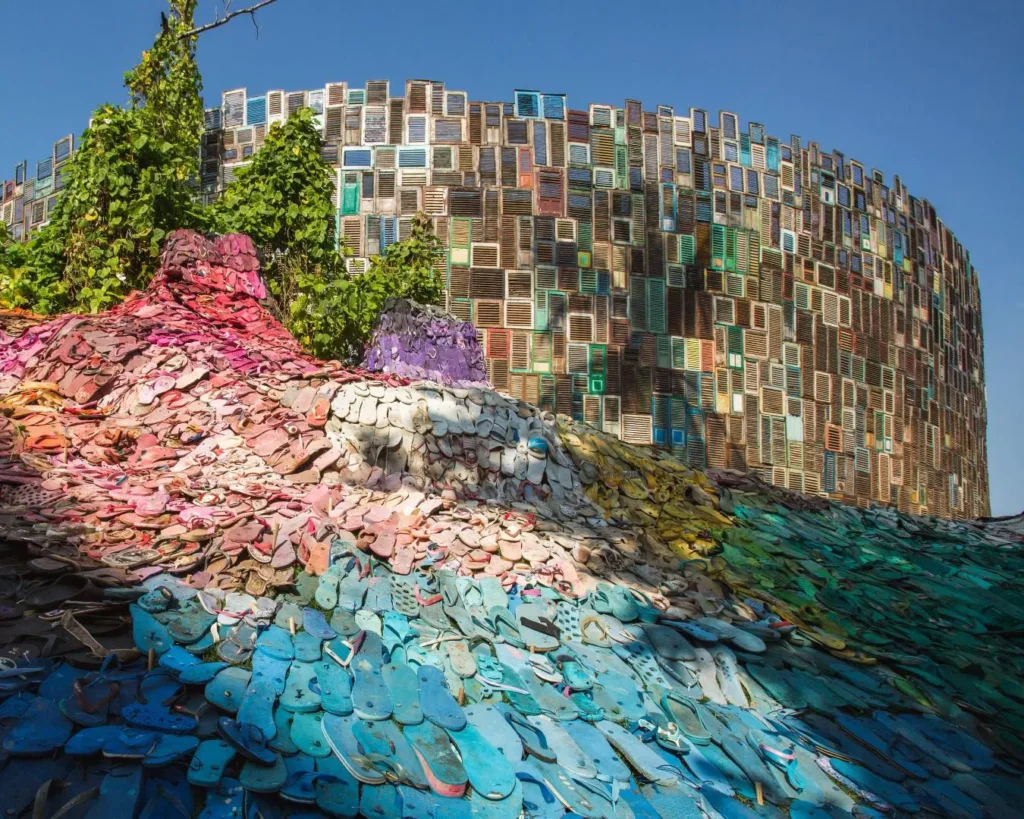
Liina Klauss’ 5,000 Lost Soles installation | Photo Credit: Desa Potato Head
Liina Klauss’ 5,000 Lost Soles installation
| Photo Credit: Desa Potato Head
Art is embedded everywhere, and it is on point to deliver Desa’s message.
Nano Uhero’s bamboo tunnel, The Womb, forms the ceremonial entrance; guests pass through it to the sound of a Balinese water blessing. In the courtyard, New York artist Futura 2000’s Pointman (built entirely from waste pulled from Bali’s waterways) stands sentinel, a symbol of the island’s philosophy of duality: transforming what’s discarded into something meaningful.
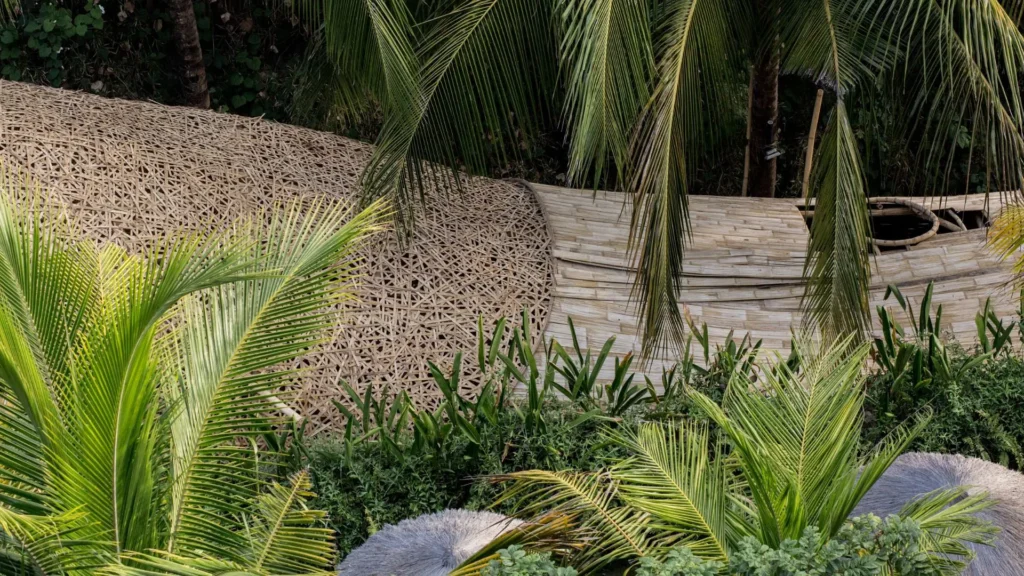
The Womb is a bamboo tunnel that forms the hotel’s entrance
| Photo Credit: Desa Potato Head
The Womb is a bamboo tunnel that forms the hotel’s entrance | Photo Credit: Desa Potato Head
Yet behind the photogenic veneer sits an operation surprisingly obsessive in its rigour.
Ronald Akili, the founder, committed to a zero-waste-to-landfill target after a 2016 surfing trip with his son, during which they found themselves surrounded by ocean plastic. Working with environment engineering consultants, Eco Mantra, and a community of forward-thinking designers and artists, the team has reduced landfill waste to less than 5%. With 950 staff, that kind of performance is no fluke. Every bag of waste is weighed, logged and directed with precision; glass becomes drinking vessels, HDPE plastic becomes chair legs or bottle caps, and suppliers are prohibited from delivering anything wrapped in plastic. Cling wrap is banned in the kitchens, a small but symbolic strike against old habits.
Guests see this engine of sustainability up close.

Waste is transformed into industrial design
| Photo Credit: Desa Potato Head
Waste is transformed into industrial design | Photo Credit: Desa Potato Head
Sustainability manager Dewa Legawa takes visitors behind the scenes to the Waste Lab, where shredded plastic is moulded into planks before being transformed into trays, furniture and amenities. It’s hospitality meets industrial design, with the transparency to back its claims. This is where Desa Potato Head stands apart: it doesn’t simply communicate sustainability; it operationalises it.

A Waste Tour at Desa Potato Head
| Photo Credit: Desa Potato Head
A Waste Tour at Desa Potato Head | Photo Credit: Desa Potato Head
The guest journey reinforces the mission. Check-in ends at the Circle Store, where upcycled amenities and limited-edition pieces crafted from waste sit alongside local collaborations. Every guest receives a zero-waste kit — a reusable RPET bag and a stainless-steel bottle refillable across the property. Families are welcomed into the fold through Sweet Potato Kids, a programme that swaps passive childcare for workshops on recycling, wellness and environmental awareness.

Photo Credit: Desa Potato Head
Photo Credit: Desa Potato Head
Design remains a significant draw. The façade is wrapped in over 1.5 million hand-pressed temple bricks; the pool is lined in handmade Batu Sakabumi stone. Rooms pair exposed concrete with mid-century accents and natural materials, a calm counterpoint to the vivid energy outside. The property’s ecosystem includes a beach club, sound studios, concept stores, a library, and interactive art — all curated to attract creatives, culture-hunters, and those who prefer their holidays with a side of intellectual stimulation.

A workshop at kids club is also based on teaching sustainability
| Photo Credit: Desa Potato Head
A workshop at kids club is also based on teaching sustainability | Photo Credit: Desa Potato Head
“Good Times Do Good” is their brand tagline, and it is, quite literally, the operating system. Desa Potato Head is Asia’s first carbon-neutral hospitality brand, and its creative lab turns waste streams into products with surprising desirability. In an industry often sluggish to adopt meaningful change, the property has become proof that sustainability and luxury aren’t competing forces; they’re mutually reinforcing.
Author: Priyanka C. Agarwal
Priyanka is a writer, editor and storyteller. Her words have appeared on the print and online pages of The South China Morning Post, SilverKris, Her World, The Michelin Guide, Time Out, and more. She has also created custom content for leading brands like Sentosa, Mediacorp Special Projects, Asia’s 50 Best, IKEA, and Meat and Livestock Australia. Her expertise includes food and drink, wellness, luxury and travel.