

L’evo At The Foothills Of Japan’s Tateyama Mountains Spotlights Experience-Driven, Hyper-Local Gastronomy
Farm, forest, and fine dining converge at this Michelin-awarded establishment in Toyama, Japan
20 March 2026
Share this exclusive content from Saladplate

L’evo’s cuisine is a celebration of its surroundings | Photo credit: L’evo
L’evo’s cuisine is a celebration of its surroundings | Photo credit: L’evo
In recent years, the global dining industry has seen a growing emphasis on sustainability and traceability. Increasingly, the question is no longer just what is being served, but where it comes from, and how it is sourced. Against this backdrop, a highly distinctive restaurant in Japan offers a case study in rethinking the foundations of luxury dining.
The village of Toga, home to L’Evo, is nestled in a remote valley surrounded by mountains rising to around 1,000 meters and bordering Gifu Prefecture. Getting around the village can take an entire day, even by car, as there is little flat land and the terrain consists of continuous mountain ranges. It is also one of the heaviest-snowfall areas in Toyama Prefecture, with snow accumulation typically reaching around 3 meters in winter and up to 4 meters at its peak.
Mountain streams run through the valleys, creating a strikingly scenic landscape. However, the harsh living conditions have led to a declining population, and the village is now considered depopulated. Yet it is precisely this isolation that has preserved its untouched natural environment, abundant resources, and what can be described as Japan’s original rural landscape.
Championing this region is L’evo’s chef-owner Eiji Taniguchi, who established the restaurant in Toga after being captivated by the region’s rich natural environment and unspoiled culture. His accolades, as well as those of L’Evo, include: Two Michelin Stars and a Michelin Green Star (2021) – Michelin Guide, “Chef of the Year” at Gault & Millau Japan (2017, 2022), A La Liste and The Tabelog Award Gold (2025).
After graduating from high school, Taniguchi began his career in the Western cuisine department of a hotel in Takarazuka, where he discovered his passion for French cuisine and decided to pursue it professionally. At 29, he trained with the three-Michelin-starred Bernard Loiseau group in France. By 34, he was head chef at River Retreat Garaku, before founding L’Evo in 2014, which was relaunched in its current avatar in 2020.
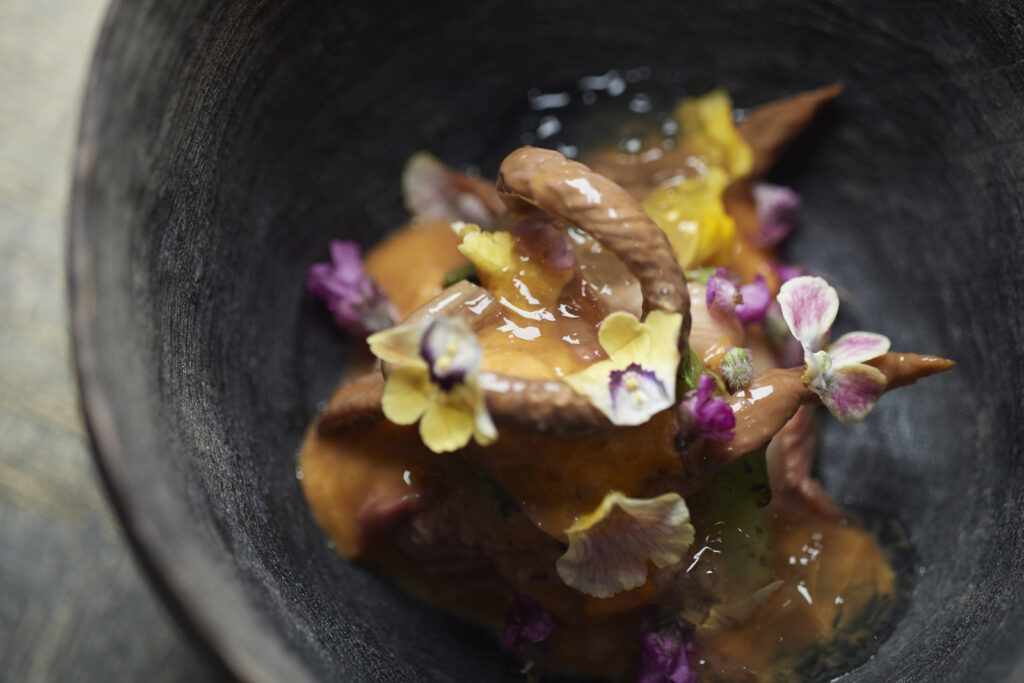
Tsukinowaguma (with dried zenmai fern and sea urchin) | Photo credit: L’evo
Tsukinowaguma (with dried zenmai fern and sea urchin) | Photo credit: L’evo
L’Evo operates on a reservation-only basis for lunch and dinner, with a confirmation call from the restaurant required prior to arrival. During this call, transportation arrangements are carefully checked—not as a formality, but as a necessity. Depending on the route, visitors may encounter narrow roads and steep inclines, making it difficult to reach without proper planning. However, this inaccessibility also helps preserve the untouched natural environment and traditional Japanese landscape that define the area.
What distinguishes L’Evo is that it goes far beyond the conventional “farm-to-table” model. Agriculture, foraging, and hunting are fully integrated, forming a unified system in which each dish results from multiple interconnected processes. Vegetables and herbs are cultivated in carefully prepared on-site soil, while wild plants, mushrooms, and even game are sourced directly from the surrounding environment. Bread is baked in a dedicated hut on the property, and even the water used for cooking and cleaning is drawn from the mountain behind the restaurant. The menu extends this philosophy, shaped by close relationships with local farmers, brewers, and winemakers, and presented on bespoke crockery by regional artisans. This sense of place carries through to the interiors: wood-grain furniture by local woodworker Shimoo Design, hidden drawers revealing delicate sake cups by Taizo Yasuda, and artwork sourced entirely from Toyama—creating a dining experience that is as rooted as it is extraordinary.
In this way, L’Evo represents a truly comprehensive expression of hyper-local gastronomy.

Exterior of the restaurant | Photo credit: L’evo
Exterior of the restaurant | Photo credit: L’evo

Entrance | Photo credit: L’evo
Entrance | Photo credit: L’evo
The complexity of L’evo’s cuisine is the product of a multidisciplinary team. Staff across various functions collaborate to shape each course, while producers, ceramic artists, and craftspeople are also integral to the process.
Everyone involved in creating the dining experience operates as part of a unified collective.
This model is underpinned by strong relationships and mutual trust. One contributing factor is chef Taniguchi’s commitment to working directly with producers, bypassing intermediaries and engaging with them face-to-face.
For industry professionals, L’evo offers more than an isolated success story. It challenges a fundamental assumption in fine dining: that luxury is defined by the acquisition of rare, globally sourced ingredients. Instead, L’evo prioritises proximity over distance, and a sense of place over conventional notions of exclusivity.
This approach may also signal a broader shift in ingredient sourcing. As environmental concerns intensify and consumer values evolve, restaurants may increasingly reconsider their reliance on global supply chains, moving toward more localised systems. L’evo may be considered a niche, hyper-local, experience-driven model, but could this be a viable, compelling and alternative model with excellent storytelling?

Restaurant | Photo credit: L’evo
Restaurant | Photo credit: L’evo


Chef Eiji Taniguchi | Photo credit: L’evo
That said, it is not without its challenges. Seasonal variability, limited production capacity, and the labour-intensive nature of sourcing and cultivation all present significant operational hurdles. Working with ingredients that cannot be easily substituted requires both resilience and adaptability.


Beet macaron and Daimon somen, a regional speciality from Toyama | Photo credit: L’evo
In this sense, every ingredient is either grown or gathered in-house, representing a true expression of local production for local consumption, an approach that few restaurants are able to achieve.
L’Evo offers 13 courses of seasonally driven, avant-garde cuisine that borrows French techniques but showcases its regional roots. It proves that fine dining’s value isn’t just luxury products but a deep connection to a place.


Photo credit: L’evo
Author: Satomi Nakamura
Satomi Nakamura is a freelance writer based in Tokyo and Singapore, covering food, travel, and culture. She focuses on local gastronomy and hospitality, exploring the relationship between food, place, and community. Her work highlights terroir-driven dining and emerging trends in the global F&B industry.